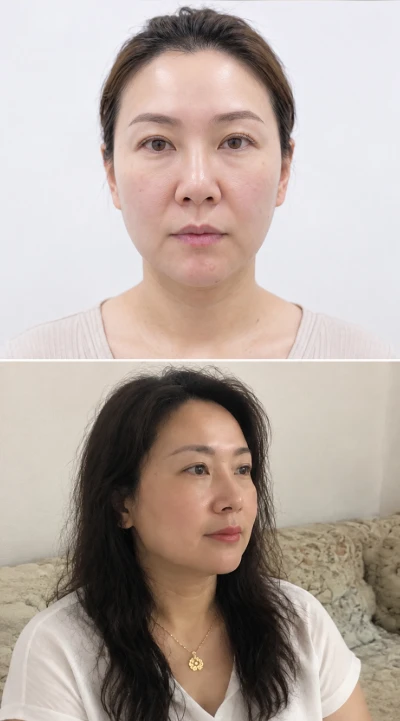
Six months after undergoing a full facelift, one 50-year-old patient decided to share her experience. Before surgery, she had spent nearly two years thinking about whether to go ahead. Along the way, she tried several anti-aging treatments, hoping to find a solution that would last.
Her experience offers a closer look at what a full facelift can do, what patients should know before surgery, and why choosing the right surgical approach matters. Here are five important points to consider when learning about facelift surgery.
1. Why She Chose a Full Facelift at Age 50
Before surgery, the patient had several noticeable signs of facial aging. Her nasolabial folds had become deeper, her jawline was less defined, and her midface tissue had descended toward the corners of her mouth.
She had previously tried treatments such as Thermage and thread lifting. While these treatments offered some improvement, she was not satisfied with how long the results lasted.
After three consultations, she gained a better understanding of the changes happening beneath her skin.
As we age, the skin and underlying facial support tissues gradually lose elasticity and begin to shift downward. Changes involving the superficial musculoaponeurotic system (SMAS), an important layer of facial support tissue, can contribute to sagging cheeks, deeper folds, and a less defined jawline.
For patients with more advanced facial laxity, simply tightening the skin may not provide the improvement they want. A full facelift can address deeper tissues as well as excess skin, depending on the surgical technique and the patient's individual needs.
For this patient, understanding the difference between surface-level treatments and surgical lifting helped her make a more informed decision.
2. Five Things to Know Before Getting a Full Facelift
1. Do Not Choose a Clinic Based on Price Alone
A full facelift is a major surgical procedure that requires appropriate medical facilities, qualified surgeons, and suitable anesthesia support.
Before choosing a clinic, patients should check its licensing and surgical qualifications, understand who will perform the procedure, and confirm that proper anesthesia and emergency support are available.
A low price should never be the main reason for choosing a provider. It is more important to understand the surgeon's experience, the proposed surgical plan, the potential risks, and the quality of postoperative care.
2. A Stronger Lift Does Not Always Mean a Better Result
It is easy to assume that the tighter the face looks after surgery, the better the result must be. In reality, excessive tension can contribute to an unnatural appearance and may place unnecessary stress on the skin and incision sites.
The goal of a well-planned facelift is not to make the face look stretched or expressionless. It is to improve sagging, restore a more defined facial contour, and maintain the patient's natural appearance.
Every face is different. The appropriate degree of lifting depends on the patient's facial anatomy, tissue quality, degree of laxity, and aesthetic goals.
A good surgical plan should focus on balanced improvement rather than maximum tightness.
3. Understand the Recovery Timeline Before Surgery
Recovery is an important part of the facelift journey, and patients should have realistic expectations before entering the operating room.
During the first two weeks, swelling and bruising may be noticeable. Some patients can return to routine social activities after approximately two weeks, but this varies depending on the extent of surgery and individual healing.
Swelling does not disappear all at once. Subtle changes in facial contour and tissue softness may continue over the following months. It can take around three to six months for the face to settle into a more stable appearance, although the timeline varies from person to person.
During recovery, patients should follow their surgeon's instructions, attend scheduled follow-up appointments, and avoid strenuous activities until cleared to resume them.
It is also worth remembering that the face may look different from one day to the next during healing. Early swelling is not a reliable indication of the final result.
4. Incision Placement and Scar Care Both Matter
Many facelift techniques place incisions around the hairline and natural folds in front of or behind the ears. The exact incision pattern depends on the surgical technique, the amount of lifting required, and the patient's anatomy.
Careful incision planning can help make scars less noticeable over time. However, scars do not disappear completely, and their appearance varies according to individual healing, skin characteristics, and postoperative care.
During the early healing period, scars may look red or feel firm before gradually becoming less noticeable. This process can take several months or longer.
Patients should keep incision sites clean according to their surgeon's instructions, protect healing skin from excessive sun exposure, and use scar treatments only when recommended by their medical team.
Following these instructions is an important part of recovery.
5. How Long Can the Results Last?
A full facelift can provide long-lasting improvement, but it does not stop the natural aging process.
In this patient's case, the six-month mark offered an opportunity to reflect on her recovery and the changes she had experienced. Her results should be understood as an individual experience rather than a guarantee for other patients.
Facelift results are sometimes described as lasting approximately five to eight years, but this is only a general estimate. Longevity depends on the surgical technique, the patient's starting condition, genetics, skin quality, lifestyle, and ongoing aging.
Maintaining a stable weight, following a consistent skincare routine, protecting the skin from the sun, and adopting healthy lifestyle habits may help support the overall appearance of the results.
Most importantly, patients should understand that surgery can improve existing signs of aging without permanently preventing new ones from developing.
Final Thoughts
For this 50-year-old patient, deciding to undergo a full facelift was not a quick or easy choice. After nearly two years of consideration and several consultations, she chose surgery because she wanted a more substantial improvement than she had achieved with previous treatments.
Her experience highlights an important point: facial rejuvenation is not about choosing the most aggressive treatment or trying to look as young as possible. It is about understanding the changes affecting your face, exploring suitable options, and making a decision that fits your needs and expectations.
For people considering a facelift, the surgeon's qualifications, surgical judgment, and ability to develop an individualized treatment plan are important factors in both safety and outcome.
Take your time, ask questions, and make sure you understand the potential benefits, limitations, risks, and recovery requirements before proceeding.